The vast majority of MRI scanners installed in Morocco run at 1.5 Tesla. It is an excellent tool for most indications: a disc herniation, a ligament tear or a bulky tumour are perfectly visible on it. A 3 Tesla scanner does not replace that machine — it answers a different question.
Signal-to-noise ratio
A field twice as strong produces roughly twice the signal. That extra signal can be spent two ways: halve the scan time, or raise spatial resolution at constant duration. In neurology, it is the second option that matters. A two-millimetre demyelinating plaque, invisible or equivocal at 1.5 T, becomes sharp and measurable.
The diagnostic threshold for multiple sclerosis rests on the number and location of lesions. When the machine sees three instead of one, the diagnosis tips — and treatment starts years earlier.
Not every indication justifies 3 Tesla, and systematically prescribing the strongest field would be a mistake — costly for the patient and clinically pointless. Our radiologists direct patients to one machine or the other according to the question asked. The question chooses the machine, never the other way round.
The author
Pr Hicham Ouazzani
Head of Department — Neurology
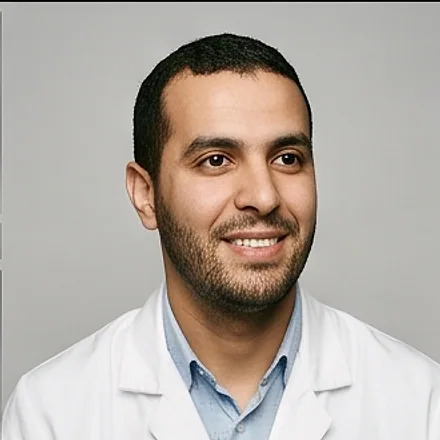
Hicham Ouazzani has published nineteen papers on multiple sclerosis in North African populations. He championed the 3 Tesla MRI purchase, convinced that in neurology two millimetres of resolution change a life.
Learn moreThis article is for information only and does not replace a medical consultation. If you have symptoms, please see a healthcare professional.